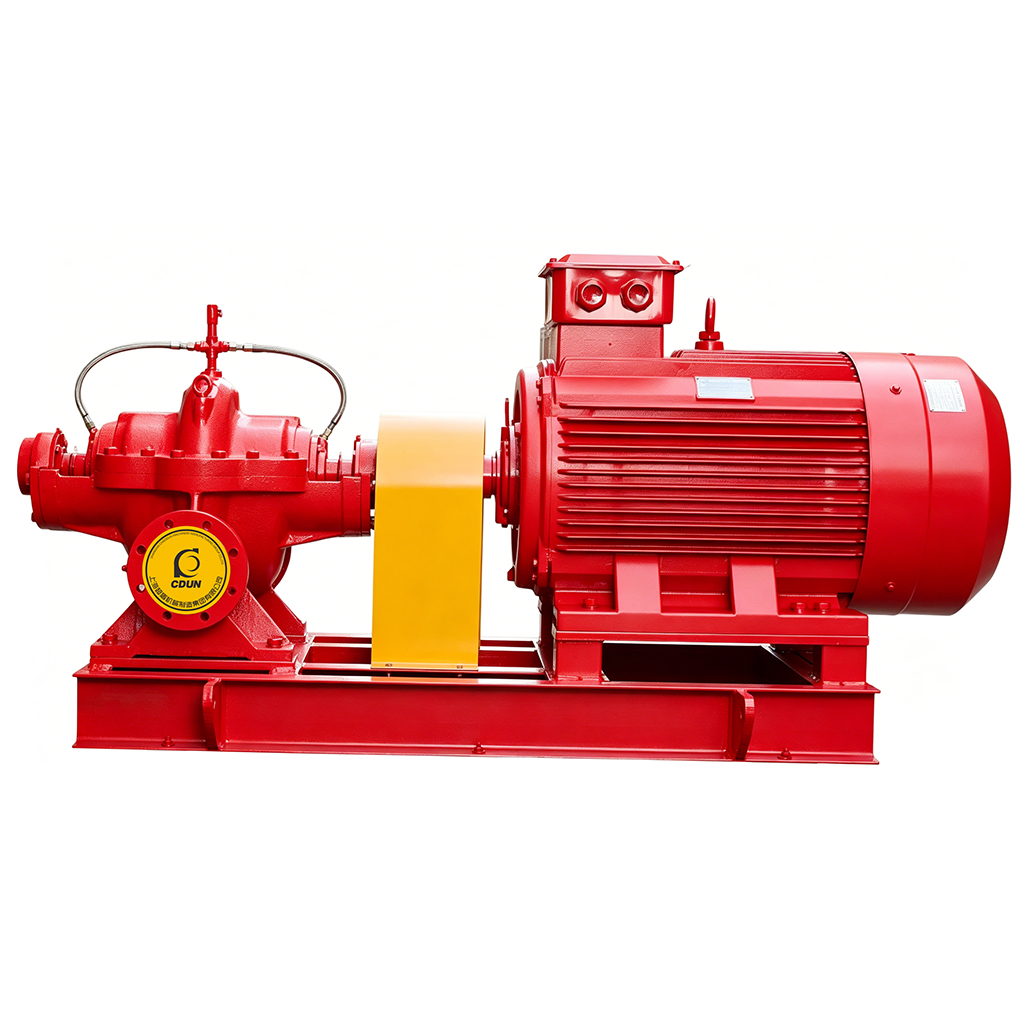


XBD-CDS Series Horizontal Split-Case Fire Pump
Horizontal split-case double-suction fire pump for high-flow fire protection systems. Flow 10-120 L/s, pressure 0.3-2.4 MPa, power up to 450 kW. UL/FM listed, NFPA 20 compliant.
Key Specifications
| Flow Rate | 10-120 L/s (158-1900 GPM) |
| Pressure | 0.3-2.4 MPa (43-348 psi) |
| Power | Up to 450 kW (600 HP) |
Product Overview
The XBD-CDS Series Horizontal Split-Case Fire Pump is a high-performance fire protection solution featuring a horizontal split-case double-suction impeller design. Also known as Horizontal Split Case Fire Pump, Double Suction Fire Pump, or Fire Water Pump in different regions, this pump delivers exceptional flow capacity and pressure for comprehensive fire suppression systems.
Engineered with a horizontally split casing that allows the upper half to be removed without disturbing suction and discharge piping, the XBD-CDS Series provides unmatched maintenance accessibility. The double-suction impeller design ensures balanced hydraulic forces, minimizing axial thrust and extending bearing life while delivering smooth, vibration-free operation.
Manufactured by Shanghai Chaodun Machinery Manufacturing Group Co., Ltd., this fire pump meets stringent international fire protection standards and is certified for use in critical life safety applications. The robust construction and precision engineering make it ideal for demanding environments where reliability is paramount.
With flow rates ranging from 10 to 120 L/s and pressures up to 2.4 MPa, the XBD-CDS Series serves diverse fire protection needs including fire hydrant systems, automatic sprinkler systems, water mist suppression systems, and deluge systems. The horizontal split-case configuration is particularly suited for large-scale commercial, industrial, and institutional facilities requiring high-capacity fire water supply.
Key Features
- Horizontal Split-Case Design – The casing splits horizontally along the centerline, allowing complete access to internal components without removing the pump from the pipeline. This design dramatically reduces maintenance time and costs while ensuring minimal system downtime.
- Double-Suction Impeller – The balanced double-suction impeller design eliminates axial thrust, reducing bearing load by up to 80% compared to single-suction pumps. This results in extended bearing life, reduced vibration, and smoother operation throughout the pump’s service life.
- High Flow and Pressure Capacity – Engineered to deliver flow rates from 10 to 120 L/s with discharge pressures up to 2.4 MPa (350 psi), meeting the most demanding fire protection system requirements for large facilities and high-rise buildings.
- Premium Material Construction – Available in cast iron, bronze-fitted, or all-bronze configurations to suit various water quality conditions and corrosion requirements. All wetted parts are designed for long-term reliability in fire protection service.
- Compliance with International Standards – Designed and tested in accordance with NFPA 20, UL/FM listing requirements, GB 6245, and EN 12845 standards, ensuring global acceptance and compliance with local fire codes.
- Flexible Drive Options – Compatible with electric motors, diesel engines, and steam turbines to provide redundancy and ensure fire pump operation during power outages or emergency scenarios.
Applications
- Fire Hydrant Systems – Primary water supply for indoor and outdoor fire hydrant networks in commercial buildings, industrial facilities, warehouses, and storage yards. The high flow capacity ensures adequate water supply for multiple simultaneous hydrant operations.
- Automatic Sprinkler Systems – Reliable water supply for wet-pipe, dry-pipe, pre-action, and deluge sprinkler systems in office buildings, hotels, shopping malls, hospitals, and manufacturing facilities. The consistent pressure ensures proper sprinkler operation throughout the protected area.
- Water Mist Fire Suppression – High-pressure water supply for water mist systems protecting critical infrastructure such as power transformers, turbine enclosures, cable tunnels, and flammable liquid storage areas. The precise pressure control ensures optimal droplet size for effective fire suppression.
- High-Rise Building Fire Protection – Dedicated fire water supply for tall buildings exceeding 100 meters in height. The high-pressure capability ensures adequate water delivery to upper floors while maintaining required flow rates for standpipe and sprinkler systems.
- Industrial Process Protection – Fire water supply for petrochemical plants, refineries, chemical processing facilities, and manufacturing plants where flammable materials present significant fire hazards. The robust construction withstands harsh industrial environments.
- Municipal and Infrastructure Fire Protection – Fire water supply for airports, seaports, railway stations, tunnels, and public transportation facilities. The reliable performance ensures life safety protection for critical public infrastructure.
Customer Benefits
- Unmatched Reliability – The horizontal split-case design and double-suction impeller provide decades of reliable service with minimal maintenance. The balanced hydraulic forces reduce wear on bearings and seals, ensuring the pump performs when needed most—during a fire emergency.
- Reduced Total Cost of Ownership – Easy maintenance access through the split-case design reduces service time by up to 70% compared to end-suction pumps. The extended bearing and seal life further reduces maintenance costs and replacement part expenses over the pump’s 20+ year service life.
- Superior Hydraulic Performance – The optimized impeller design and precision-cast volute deliver peak efficiency across the operating range, reducing energy consumption by 15-25% compared to conventional fire pumps. Lower operating costs translate to significant savings over the system lifetime.
- Flexible Installation Options – The horizontal configuration allows installation in spaces with limited vertical clearance. The split-case design permits motor and driver removal without disturbing piping connections, simplifying installation and future maintenance in congested pump rooms.
- Global Compliance and Certification – With UL/FM listing, CE marking, and compliance with NFPA 20, the XBD-CDS Series meets international fire protection standards. This global acceptance simplifies specification for multinational projects and ensures compliance with local fire codes worldwide.
- Comprehensive Technical Support – Backed by Shanghai Chaodun’s engineering expertise and global service network, customers receive complete technical support from system design through installation, commissioning, and lifetime maintenance. Detailed performance curves, dimensional drawings, and installation manuals ensure successful project execution.
Technical Specifications
| Parameter | Specification |
| Flow Rate Range | 10-120 L/s (158-1900 GPM) |
| Discharge Pressure | 0.3-2.4 MPa (43-348 psi) |
| Motor Power Range | Up to 450 kW (600 HP) |
| Pump Speed | 1450/2900 RPM (50Hz), 1750/3500 RPM (60Hz) |
| Suction Flange Size | DN150-DN400 (6″-16″) |
| Discharge Flange Size | DN100-DN300 (4″-12″) |
| Maximum Working Pressure | 2.5 MPa (362 psi) |
| Maximum Temperature | 80°C (176°F) standard, up to 120°C (248°F) optional |
| Pump Casing Material | Cast Iron (GG25), Ductile Iron (GGG40), Bronze |
| Impeller Material | Bronze, Stainless Steel, Cast Iron |
| Shaft Material | Carbon Steel, Stainless Steel (AISI 410/431) |
| Seal Type | Mechanical seal or packed gland |
| Bearing Type | Anti-friction ball/roller bearings or sleeve bearings |
| Rotation | Clockwise viewed from drive end |
| Flange Standard | GB/T 17241.6, ISO 7005-2, ASME B16.1, EN 1092-2 |
| Performance Testing | GB/T 3216, ISO 9906, HI 14.6 |
| Fire Rating | UL/FM Listed, NFPA 20 compliant |
Selection Guidance
Selecting the right XBD-CDS Horizontal Split-Case Fire Pump requires careful consideration of system requirements and application specifics:
- Determine System Flow Requirements – Calculate total fire water demand based on the most demanding scenario: simultaneous operation of fire hydrants, sprinkler systems, and water mist systems. Consider the hazard classification and occupancy type per NFPA 13, NFPA 14, or local fire codes.
- Calculate Required Pressure – Determine the total dynamic head including static elevation, friction losses in piping, and residual pressure required at the most remote hose connection or sprinkler. Include a 10-15% safety margin for system degradation over time.
- Select Appropriate Materials – For standard freshwater applications, cast iron construction is suitable. For corrosive water sources or seawater applications, specify bronze-fitted or all-bronze pumps. Consider water quality analysis when selecting materials.
- Choose Drive Configuration – Electric motor drive is standard for reliable power supply. Diesel engine drive provides redundancy during power outages and is required by many fire codes for critical facilities. Consider dual-drive configurations for maximum reliability.
- Evaluate Space Constraints – The horizontal split-case design requires adequate clearance for motor removal and maintenance access. Ensure sufficient space for piping connections, valve operation, and future maintenance. Consider the pump room layout and access routes for equipment installation.
- Consider Future Expansion – Select a pump with capacity for potential system expansion. The XBD-CDS Series offers flexibility for future increases in fire protection demand without requiring pump replacement.
Installation and Maintenance
Installation Requirements:
- Foundation: Install on a level, reinforced concrete foundation with adequate mass to absorb vibration. The foundation should extend at least 150mm beyond the pump baseplate on all sides.
- Alignment: Use laser alignment tools to ensure precise shaft alignment between pump and driver. Thermal growth compensation is critical for pumps operating at elevated temperatures.
- Piping Support: Provide independent support for suction and discharge piping to prevent loads on pump flanges. Use flexible connectors or expansion joints to accommodate thermal expansion and settlement.
- Suction Conditions: Ensure adequate NPSH (Net Positive Suction Head) by minimizing suction pipe friction losses and avoiding air pockets. Install eccentric reducers with the flat side up to prevent air accumulation.
- Ventilation: Provide adequate ventilation for motor cooling and diesel engine exhaust removal. Maintain pump room temperature below 40°C (104°F) for optimal equipment life.
- Access Clearance: Maintain minimum 1-meter clearance around the pump for maintenance access. Ensure overhead clearance for lifting equipment during major service operations.
Maintenance Schedule:
- Weekly: Visual inspection for leaks, unusual noise, or vibration. Check bearing temperature and seal leakage. Verify oil levels in bearing housings.
- Monthly: Run the pump for at least 30 minutes under no-flow conditions to prevent seizing. Check motor insulation resistance. Inspect coupling condition.
- Quarterly: Measure and record vibration levels. Check alignment. Inspect packing gland adjustment or mechanical seal condition.
- Annually: Perform flow and pressure test to verify performance. Inspect bearings and replace if necessary. Check impeller clearance and wear ring condition.
- Every 3-5 Years: Complete pump overhaul including bearing replacement, seal replacement, and impeller inspection. Perform hydrostatic test on casing.
Maintenance Tips:
- Keep detailed maintenance logs to track performance trends and predict component failures
- Use only OEM-approved spare parts to maintain performance and warranty coverage
- Maintain proper lubrication with recommended grease or oil types
- Monitor vibration trends to detect developing problems before they cause failures
- Train operating personnel on proper pump operation and emergency procedures
Available Configurations
The XBD-CDS Series offers extensive customization to meet specific project requirements:
Pump Configurations:
- Single pump unit for dedicated fire water supply
- Duplex pump system with automatic lead-lag control for redundancy
- Triplex pump system for critical facilities requiring maximum reliability
- Jockey pump integration for pressure maintenance in sprinkler systems
Material Options:
- Cast iron casing with bronze impeller (standard)
- All-bronze construction for seawater or corrosive applications
- Ductile iron for high-pressure applications
- Stainless steel trim for specialized applications
Drive Options:
- Electric motor drive (TEFC or explosion-proof motors)
- Diesel engine drive with automatic transfer switch
- Steam turbine drive for facilities with steam availability
- Dual-drive configuration (electric + diesel) for maximum reliability
Control Options:
- Basic start/stop control with manual operation
- Automatic pressure-based start/stop control
- Fire alarm system integration with automatic pump start
- Remote monitoring and diagnostics via SCADA system
- VFD (Variable Frequency Drive) for energy optimization in variable flow applications
Accessory Options:
- Pressure relief valves for system overpressure protection
- Flow meters for performance monitoring
- Pressure gauges and transmitters for system monitoring
- Vibration sensors for predictive maintenance
- Bearing temperature sensors for early warning of problems
FAQs
Q1: What is the difference between a horizontal split-case pump and an end-suction pump?
A horizontal split-case fire pump (also called split case fire pump or double suction fire pump) has a casing that splits horizontally along the shaft centerline, allowing the top half to be removed for maintenance without disturbing the piping. An end-suction pump has a casing that opens at the back, requiring complete disconnection of piping for maintenance. Split-case pumps offer easier maintenance, higher flow capacity, and better hydraulic balance for fire protection applications.
Q2: Why choose a double-suction impeller design?
The double-suction impeller design provides balanced hydraulic forces that eliminate axial thrust, reducing bearing load by up to 80% compared to single-suction impellers. This results in extended bearing life, reduced vibration, and smoother operation. The balanced design also allows higher speeds and pressures while maintaining reliability, making it ideal for fire pump applications where consistent performance is critical.
Q3: What is the expected service life of the XBD-CDS Series?
With proper installation, operation, and maintenance, the XBD-CDS Series Horizontal Split-Case Fire Pump provides 20-25 years of reliable service. The split-case design and double-suction impeller minimize wear on bearings and seals, while premium materials ensure long-term corrosion resistance. Regular maintenance per the recommended schedule maximizes service life and ensures reliable operation during fire emergencies.
Q4: Can the XBD-CDS Series be used with seawater or corrosive water sources?
Yes, the XBD-CDS Series is available in all-bronze construction specifically designed for seawater and corrosive water applications. Bronze-fitted pumps (cast iron casing with bronze impeller and wear rings) are suitable for brackish water. For highly corrosive applications, consult with our engineering team for specialized material recommendations and coating options.
Q5: What certifications does the XBD-CDS Series have?
The XBD-CDS Series is UL/FM listed for fire pump service, CE marked for European markets, and compliant with NFPA 20, GB 6245, and EN 12845 standards. The pumps are tested and certified by recognized third-party laboratories including UL (Underwriters Laboratories) and FM (Factory Mutual). Additional certifications are available for specific regional requirements.
Q6: How do I select the right pump size for my application?
Pump selection requires calculation of system flow demand and total dynamic head. Start by determining the most demanding fire scenario (simultaneous operation of hydrants, sprinklers, and water mist systems). Calculate friction losses in piping using the Hazen-Williams or Darcy-Weisbach equations. Select a pump from the XBD-CDS performance curves that operates near the best efficiency point (BEP) at your required duty point. Our engineering team provides free pump selection assistance—contact us with your system requirements for a detailed recommendation.
Contact Chaodun
For technical consultation, pump selection assistance, or quotation requests for the XBD-CDS Series Horizontal Split-Case Fire Pump, contact our fire protection engineering team:
Shanghai Chaodun Machinery Manufacturing Group Co., Ltd.
Website: https://chaodunpump.com
Email: Suzion@chaodunpump.com
WhatsApp: +44 751 8050 473
Phone: +86 21 5744 5678
Our fire pump specialists provide comprehensive support from initial system design through installation, commissioning, and lifetime maintenance. We offer detailed performance curves, dimensional drawings, installation manuals, and technical submittals for your project specifications.
Whether you’re designing a new fire protection system or upgrading an existing installation, our engineering team ensures you select the optimal XBD-CDS configuration for your specific application requirements and budget constraints.